More than US$483 million in insurance payouts has reopened roads, rebuilt schools and water systems, restored power, replanted farms and put cash in the hands of vulnerable families, each payout delivered within 14 days. This is what fast, rules-based financial protection looks like on the ground.
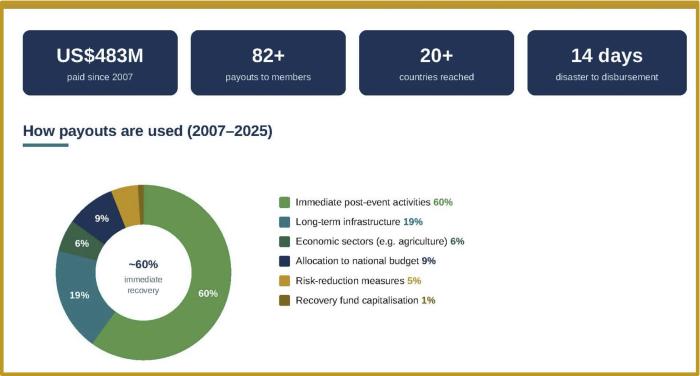
For a small island or low-lying coastal nation, the most dangerous hours of a disaster are often the ones that come after - the long wait for money to clear roads, reopen clinics and restore power. It is in that gap that a manageable emergency hardens into a lasting economic setback. For nineteen years, CCRIF SPC has existed to close that liquidity gap. Since 2007 it has paid out more than US$483 million across some 82 payouts to over twenty countries and public utilities - after earthquakes, hurricanes and excess-rainfall events. Every payout has been made within 14 days. Not once, in nearly two decades, has that promise been broken.
Why “Development Insurer” Matters
CCRIF is the Caribbean and Central America’s parametric insurance facility, and the world’s leading development insurer. Established in 2007 after Hurricane Ivan wiped out more than 200% of Grenada’s GDP in a single night in 2004, it became the world’s first multi-country, multi-peril risk pool. Today it serves 39 members with US$1.8 billion in coverage in force. An ordinary insurer exists to indemnify losses; CCRIF exists to protect development itself, absorbing the fiscal shock so recovery can begin before losses cascade into lost school years and deepening poverty etc. Its policies pay on the measured intensity of an event against a model agreed in advance, so payouts are automatic once a threshold is crossed. No loss adjusters, no disputes, only fast, predictable liquidity when a government or utility needs it most.
|
“…delivering liquidity without delay, negotiation, or conditionality.” The Most Hon. Andrew Holness, Prime Minister of Jamaica, following Hurricane Melissa (2025) and the US$91.9M in payouts CCRIF made within 14 days. |
How CCRIF Payouts are Used Across the Region, 2007 – Present
Reaching the Most Vulnerable
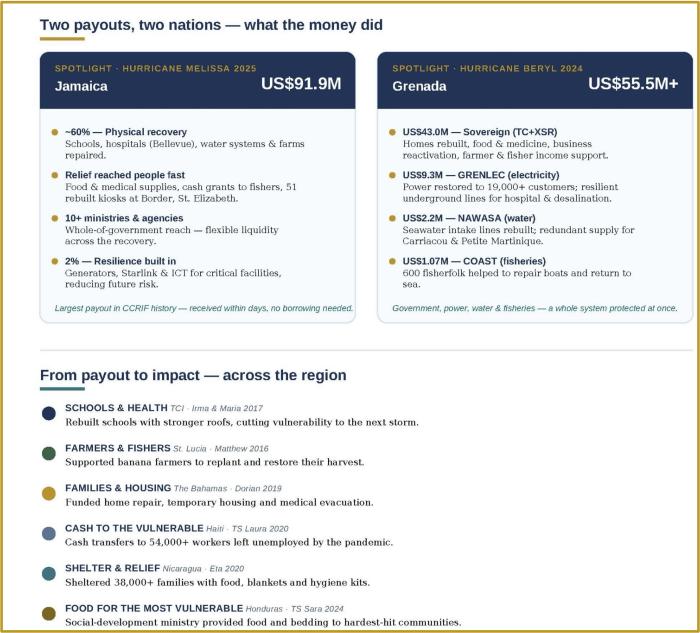
A common misconception is that sovereign insurance benefits only national treasuries. The record shows otherwise. After excess rainfall in Trinidad in 2018, payouts provided building materials and appliances to affected families. In Haiti, a payout kept civil servants paid and subsidized school fees after the 2021 earthquake; a later payout funded cash transfers to tens of thousands left unemployed by the pandemic. In Nicaragua, payouts supported more than 38,000 families placed in shelters. This household reach is now being deepened through the CCRIF–World Food Programme (WFP) top-up model – in which WFP provides a small addition to a country’s premium that channels a defined share automatically into shock-responsive social protection. After Hurricane Beryl, St. Vincent and the Grenadines used the portion of the payout from the top-up to issue over 4,600 safety-net payments and support 5,670 farmers and fishers recover faster.
Protecting the Systems a Country Depends On
CCRIF now insures not only governments, but the public utilities – electricity and water - communities cannot function without — assets private insurance markets often consider uninsurable. After Beryl, the organization paid US$9.3M to Grenada’s electricity utility Grenlec, which in turn helped the utility to restore power to more than 19,000 customers. A portion of the payout was also used to invest in resilient underground infrastructure. A US$2.2M payout was also made to the water authority NAWASA. A separate COAST payout helped some 600 fisherfolk return to sea. Each payout protected a service - power, water, food - on which lives and livelihoods directly depend.
|
“The payout gave us the flexibility and liquidity to procure items, settle expenses and disburse funds directly after the hurricane, speeding up recovery and negating the need to incur debt.” — NAWASA, Grenada, following Hurricane Beryl (2024) |
The Caribbean and Central America sit in a climate–economy trap: repeated shocks erode development gains faster than countries can rebuild. Pre-arranged, rules-based finance breaks the cycle, not by covering every loss, but by buying governments time to act decisively in the critical first days. Nineteen years on, CCRIF’s promise remains unchanged and, event after event, its value proposition kept - payouts within 14 days.
|
CCRIF AT A GLANCE 39 members · 8 parametric products · US$1.8B coverage in force US$483M paid across 82 payouts since 2007 · 14 days max from disaster to disbursement - a promise never broken |