A Bigger Shield for the Caribbean and Central America in 2026/27… Record Coverage, New Members & Stronger Protection for the Blue Economy
CCRIF enters the 2026 Atlantic Hurricane Season stronger than ever. For the 2026/27 policy year, total coverage in force has risen to US$1.8 billion, up from US$1.44 billion the previous policy year. Membership has grown from 35 to 39 members. Behind those numbers is a clear story: more governments and utilities across the region are choosing pre-arranged, rules-based financial protection, and choosing it in greater depth. As Hurricanes Ivan, Maria and Melissa each showed, it only takes one storm to change a country’s trajectory and members are acting now, with foresight.
Coverage Up to US$1.7 Billion
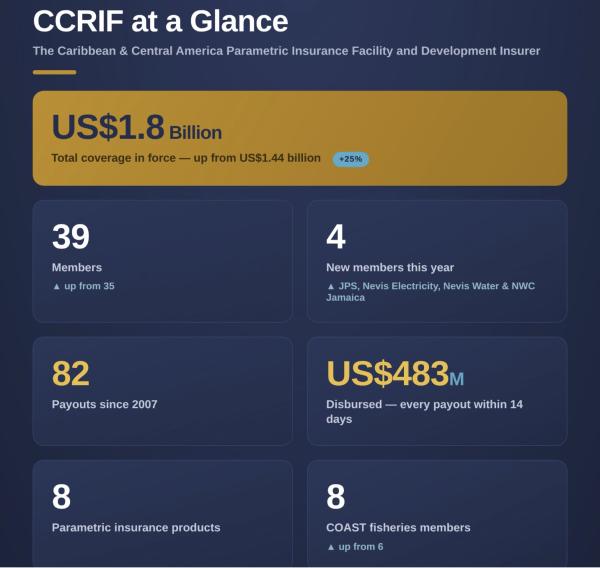
Total coverage in force has grown from US$1.44 billion in the 2025/26 policy year to US$1.8 billion this policy year, an increase of 25 per cent - with gains across both the Caribbean and Central America portfolios, reflecting expanding protection across sovereigns, water & electric utilities and fisheries. More coverage means a larger, more diversified risk pool, which strengthens CCRIF’s financial resilience and its capacity to absorb large, single-country events without compromising its promise to every other member. Since 2007, CCRIF has made 82 payouts totalling US$483 million - every one of these payouts within 14 days.
This growth strengthens CCRIF’s position as the world’s leading development insurer, delivering fast, rules‑based liquidity within 14 days and safeguarding members’ development gains when disasters strike.
Growing to 39 Members - Utilities Step Up
Membership has expanded from 35 to 39, with four new members welcomed into the CCRIF family this season. Notably, all four are utilities:
- Jamaica Public Service Company (JPS) - electric utility (transmission and distribution) coverage for Jamaica. JPS’s entry follows the devastating impact of Hurricane Melissa (2025), which severely damaged Jamaica’s electricity grid. The utility’s decision to join CCRIF underscores a regional trend: critical infrastructure providers are increasingly adopting parametric insurance to ensure continuity of essential services.
- National Water Commission, Jamaica (NWC) - NWC’s membership expands water utility protection in Jamaica, ensuring rapid liquidity for water and sanitation systems after extreme events.
- Nevis Electricity Company Limited - expanding the electric utilities portfolio to Nevis and strengthening CCRIF’s electric utilities portfolio in the Eastern Caribbean
- Nevis Water Department - bringing water utility coverage to Nevis.
These additions reflect a growing recognition among utilities, not just governments, that pre-arranged financing is essential to financial stability. Hurricane Melissa, which caused losses equivalent to more than half of Jamaica’s GDP, laid bare how a single storm can knock out the essential services that communities and economies depend on. By taking up parametric coverage, these utilities can restore power and water faster after disaster strikes.
|
These additions reflect a growing recognition among utilities, not just governments, that pre-arranged financing is necessary for financial stability.
|
COAST for fisheries Expands: Jamaica and Antigua & Barbuda Comes On Board
CCRIF also welcomes the Governments of Jamaica’s and Antigua & Barbuda’s decision to purchase the COAST for fisheries product – the organization’s parametric solution for the fisheries sector bringing the number of Caribbean countries with COAST fisheries insurance to eight, up from six in 2025/26. Jamaica’s decision for example, follows the severe impacts of Hurricane Melissa, which caused:
- US$35 million in fisheries losses
- Destruction of over 3,200 vessels (~45% of the national fleet)
- Damage to gear sheds, processing facilities, and aquaculture operations
COAST fills a critical gap by covering:
- Adverse Weather - cumulative bad‑weather days that shut down fishing activity
- Tropical Cyclone Damage - vessels, gear, landing sites, and infrastructure
- Wave Action - a new hazard module introduced in 2026 which is triggered by wave height; and compensates for events when waves impact the sector but there is insufficient wind to trigger the tropical cyclone tiers 2 and 3.

COAST is the only instrument designed specifically for these risks. Its Adverse Weather Component pays out when cumulative bad-weather interruptions exceed a trigger, capturing the frequent rough-sea events that shut down fishing but do not trigger tropical cyclone or excess-rainfall policies, while its Tropical Cyclone Component covers direct damage to fisheries infrastructure (jetties, landing sites etc.) to vessels, gear and community fisheries resources. With the two new countries on board – Jamaica and Antigua & Barbuda - COAST reaches a new level of scale and maturity. COAST now protects eight countries and is rapidly becoming a cornerstone of regional blue‑economy resilience.
CCRIF Parametric Insurance… One Layer in a Complementary Ecosystem

|
Figure 1: Risk Layers and Corresponding Disaster Risk Financing Instruments |
This year’s growth reinforces a central lesson from recent events: no single instrument can meet all post-disaster financing needs, which is why risk layering matters. Jamaica’s response to Hurricane Melissa showed the model in action - the Government received US$91.9 million from CCRIF within 14 days, alongside US$150 million from its catastrophe bond and US$300 million in contingent credit, while strengthening rather than depleting its National Natural Disaster Fund. CCRIF is not a replacement for these instruments; parametric insurance which CCRIF provides is the fast-liquidity layer that gets money moving in the critical first days.
Hear It From Our CEO
As the region moves through the 2026 Atlantic Hurricane Season, a Super El Niño year in which even a quieter season is not a safe season. CCRIF CEO Mr. Isaac Anthony shared his annual Hurricane Season message in June on what this bigger shield means for members and why preparedness matters now more than ever.
▶ Watch the CEO’s Hurricane Season 2026 message: Click here to listen again
|
“A quieter season does not mean a safe season”.
|
A Defining Year of Regional Resilience
The 2026/27 policy year demonstrates that Caribbean and Central American governments and utilities are not waiting for the next disaster, they are preparing with foresight, discipline, and innovation. CCRIF’s expanded coverage, growing membership, and strengthened sectoral protection reflect a shared regional commitment to:
- Protect lives and livelihoods
- Safeguard development gains
- Build climate‑resilient economies
- Close the protection gap
- Deliver resilience at scale
This is parametric power, and it is transforming the Wider Caribbean Region’s (Caribbean and Central America) ability to recover stronger, faster, and more equitably.
|
THE 2026/27 HEADLINE Coverage up to US$1.7 billion · membership up to 39 · JPS, Nevis Electricity, Nevis Water and NWC join, plus Jamaica’s first COAST policy. A bigger shield for a region on the frontline of climate change. |