Two CCRIF - UWI Disaster Risk Financing Programmes Completed this Quarter
CCRIF closed the quarter having graduated another 61 students across its two flagship education programmes with The University of the West Indies - the postgraduate CCRIF–UWI course and the youth summer course, both in disaster risk financing. Both are building a growing community of Caribbean nationals who understand disaster risk financing and can carry that knowledge into the region’s ministries, classrooms, businesses and communities.
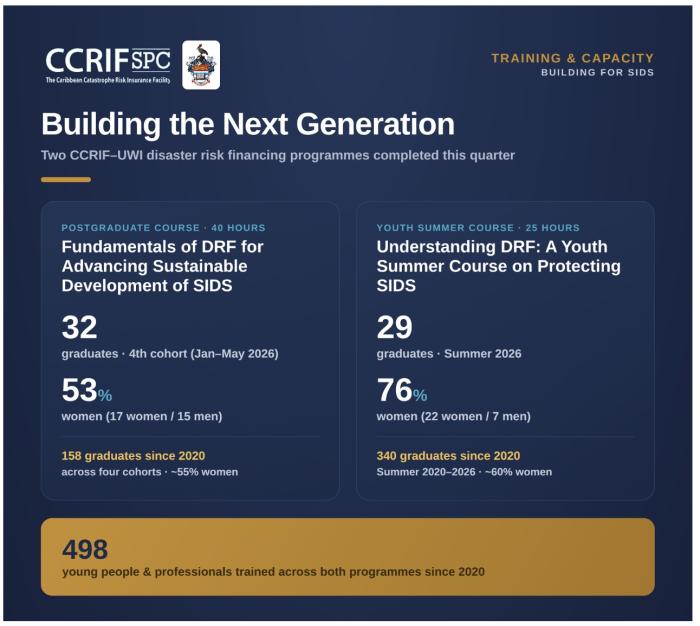
This quarter’s two CCRIF–UWI training programmes at a glance.
The Postgraduate Course (40 hours): Deep Technical Grounding in DRF - 4th Cohort - January to May 2026 – 32 Graduates
The 40-hour postgraduate course, "Fundamentals of Disaster Risk Financing for Advancing Sustainable Development of Small Island Developing States,” completed its fourth cohort between January and May 2026, graduating 32 participants - 17 women and 15 men, a 53 per cent female share, consistent with CCRIF’s commitment to gender-responsive capacity building. Delivered over 40 hours, the course provides a deep dive into:
- Multi-hazard risk environments in SIDS
- Climate change and adaptation economics
- Disaster risk financing instruments and risk layering strategies
- Parametric insurance and catastrophe modelling
- Shock-responsive social protection and microinsurance
Across its four cohorts since 2020, the postgraduate course has now produced 158 graduates, approximately 55 per cent of them women. The course continues to strengthen technical capacity in disaster risk financing, comprehensive disaster risk management and climate change (mitigation, adaptation, loss & damage) across Caribbean governments and regional institutions.
The Youth Summer Course in DRF (20 hours): Reaching the Next Generation – 29 Graduates
On 5 August 2026, CCRIF completed its 20-hour youth summer course, this year re-titled “Understanding Disaster Risk Financing: A Youth Summer Course on Protecting SIDS.” Designed for young people aged 18 to 28 and requiring no advanced mathematics or finance background, the course blends lectures, short talks, real Caribbean examples, group activities and a hands-on team challenge across five modules - from the building blocks of risk and climate change to how parametric insurance and social protection help economies recover faster after disasters.
This summer’s cohort saw 29 young people successfully complete the programme - drawn from countries across the Caribbean, with women making up 76 per cent of. Since this programme began in 2020, the youth course has now reached 340 young people, around 60 per cent of them women, nurturing a new generation of climate-aware, finance-literate Caribbean leaders.
|
No advanced mathematics or finance background is required, just curiosity about climate, finance, development and the future of the Caribbean. |
Education as a Resilience Strategy – Strengthening Regional Capacity from Youth to Senior Professionals
Together, these two programmes reflect CCRIF’s multi-level approach to capacity building in disaster risk financing:
- Youth Programme: building early awareness, leadership, and technical curiosity among future professionals.
- Postgraduate Programme: strengthening advanced technical skills among current practitioners and decision makers.
Both programmes continue to play a critical role in closing the region’s knowledge gap in disaster risk financing, ensuring that Caribbean SIDS are equipped with the human capital needed to design, implement, and sustain resilience strategies.
This investment in people is central to CCRIF’s mandate as a development insurer: strong, informed institutions and an engaged next generation are what turn financial protection into lasting resilience.
|
2026 COHORTS IN NUMBERS 32 postgraduate graduates · 29 youth-course graduates · 498 trained across both programmes since 2020 - the majority women. |