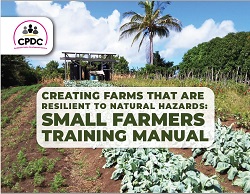
Overview of CCRIF Small Grants Programme
Under the Small Grants Programme, CCRIF will finance small projects conceptualised and managed by non-governmental organisations (NGOs), community-based organisations (CBOs), charity organisations and/or mandated by National Disaster Coordinators in local communities across CCRIF member countries and/or CARICOM member countries.
Each project should fall within the range of US$5,000 to US$25,000.
All projects submitted for consideration must be of relevance to CCRIF and its regional mandate and agenda and can therefore be inclusive of, but not limited to projects related to the following broad areas:
- Disaster risk management
- Engineering
- Climate change adaptation
- Training and other capacity building initiatives to be implemented through seminars, workshops, community consultations, and expert group meetings among others
- Environmental management initiatives that will directly impact on reducing community vulnerability (e.g. watershed management projects in degraded areas, which will contribute to enhancing resilience in nearby communities)
|
THE CCRIF SMALL GRANTS PROGRAMME AT A GLANCE 76 projects since 2015 · US$4M+ invested to date · grants of US$5,000–US$25,000 · applications open year-round. |
Eligibility
All registered NGOs, CBOs, charity or non-profit organisations, national disaster coordinating bodies and universities operating within local communities across CCRIF member countries in the Caribbean and/or CARICOM member countries are eligible for funding.
Organisations directly funded from state budgets such as departments or agencies within government ministries are not eligible for funding.
Submission Guidelines
Proposals must be submitted electronically using the CCRIF website and specifically through the CCRIF Small Grants online platform located at here.
The online system is configured for applicants to register and submit the proposal themselves. The basic steps for submitting the proposal are:
Step 1 - Registration: Create an account (username and password) for your organisation (Organisations will only be required to register once) by clicking here.
Step 2 - Organisation Profile: All the required information has to be completed, before the account can be created.
Step 3 - New Proposal: To submit a new proposal, go to the Small Grants Proposal Submission page and follow the instructions that appear (complete the application information. (Note: The link to submit a proposal is accessible to only registered "Small Grants users"!)
Deadlines for Applications
Proposals for small grants may be submitted for consideration at any time during the year. As such, CCRIF will not have a specific call for small grant proposals. Proposals will be evaluated every quarter.
Applicants can access the online small grants platform to update their registration information and note any changes to their organization.
Language
English is the official language of CCRIF and therefore project proposals and all official correspondence with the facility must be submitted in English.
Expected information to be included in the project proposal, details about the project selection criteria, announcements of results, contractual terms, and project implementation - can be found here.
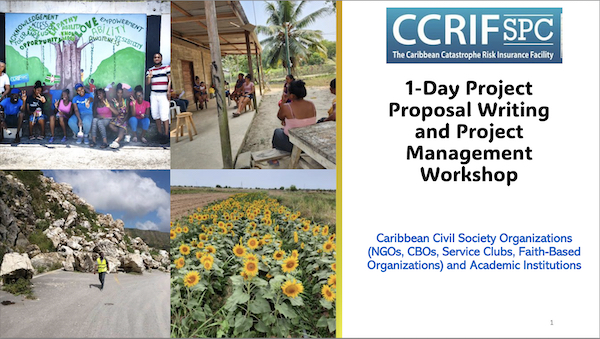
Strengthening Community Resilience: CCRIF Approves Seven New Small Grants Projects for 2025 with an Investment of US$170,000
CCRIF approved seven new projects under its Small Grants Programme in 2025, representing an investment of ~US$150,000 in community‑level resilience across the Caribbean. With these additions, CCRIF currently has 17 active projects in implementation, with an investment of US$372,000. Since the programme began in 2012, CCRIF has awarded 72 grants totalling over US$4 million, supporting civil society organizations, NGOs, academic institutions, and community groups working to reduce vulnerability and strengthen climate and disaster resilience. The 2025 approvals will further increase both the number of supported initiatives and the total value of CCRIF’s investment in grassroots resilience.
Projects approved in 2025 span a wide range of themes — from climate‑smart agriculture and youth development to disaster risk reduction, environmental stewardship, and digital innovation. Together, they reflect the creativity and commitment of Caribbean organizations working to build safer, more resilient communities.
2025 Projects at a Glance
1. Youth Empowerment & Climate Education
These initiatives build the next generation of climate leaders through hands‑on learning, training, and community engagement.
- Youth Agriculture Innovation & Resilience Programme – Dominica
Training 30 rural youth (ages 11–20) in climate‑smart farming, agro‑processing, coding, and agripreneurship, including starter kits and an agri‑business pitch competition. - Junior Climate Resilience Champions – Dominica
A two‑month programme training 125 children (ages 5–15) in disaster preparedness, engineering for climate resilience, environmental action, and climate‑themed art. - NextGen Mappers – Jamaica & Trinidad and Tobago
Training 80 high school students in GIS and disaster risk management, establishing GIS clubs, and supporting student‑led hazard mapping projects. - Agrivoltaics Demonstration – The Arboretum Conservancy, Trinidad & Tobago
Integrating solar energy with crop cultivation to demonstrate climate‑smart land use, reduce emissions, and train farmers and students in sustainable agriculture.
2. Environmental Stewardship & the Circular Economy
These projects promote environmental protection, waste reduction, and sustainable community practices.
- Ocean Love: No Plastic, No Waste – Antigua and Barbuda
Engaging 200 youth in plastic pollution awareness, beach cleanups, and upcycling workshops, converting plastic waste into durable products such as school benches. - Climate Awareness & Community Resilience – Kiwanis Foundation of Jamaica and Kiwanis 23 East
A national programme engaging more than 300 children and youth in environmental education, disaster preparedness, tree planting, and climate‑themed activities.
Building Impact Across the Region
Collectively, the projects approved in 2025 will:
- Train more than 450 youth and children in climate resilience, agriculture, GIS, and environmental stewardship
- Strengthen critical community infrastructure
- Reduce plastic pollution and promote circular economy solutions
- Expand access to climate‑smart agriculture and renewable energy
- Support community‑level disaster preparedness
- Generate new tools, training materials, and models that can be replicated across the Caribbean
These initiatives demonstrate how small grants can catalyze big change - empowering communities, protecting vulnerable groups, and building long‑term resilience from the ground up. As implementation begins, CCRIF looks forward to sharing stories of innovation, leadership, and community transformation throughout the year.



 Small Grants Proposal Submission (*** Registered users)
SGP Project Publications