As we begin 2026, I extend warm greetings to all our members, partners, and 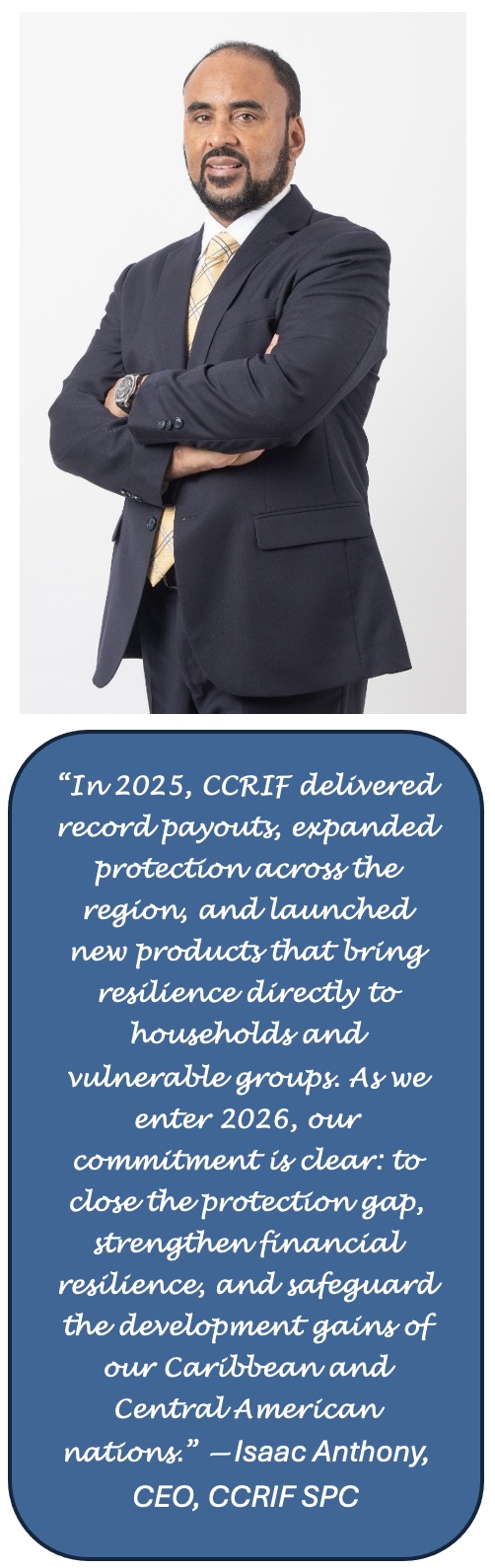 stakeholders. The past year was one of both immense challenge and extraordinary progress for CCRIF, as we continued to strengthen our role as the Caribbean and Central America’s development insurer and a global leader in parametric insurance.
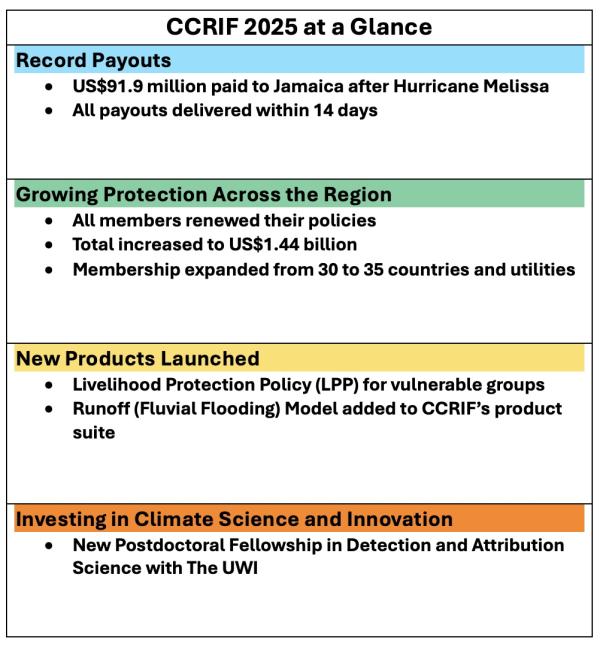
Hurricane Melissa was the defining event of 2025. Its devastation across Jamaica and parts of the northern Caribbean underscored the accelerating climate risks facing our region. In response, CCRIF delivered US$91.9 million in payouts to the Government of Jamaica under its tropical cyclone and excess rainfall policies, the largest combined payout in our history. These funds were disbursed within our 14‑day window, providing rapid liquidity to stabilize essential services, support vulnerable populations, and jump‑start recovery efforts.
Yet our work extended beyond payouts. In 2025, all CCRIF members renewed their parametric insurance policies, bringing total coverage across the Facility to US$1.44 billion. This strong vote of confidence reflects the value our members place on CCRIF’s reliability, affordability, and speed of payouts, especially as climate extremes intensify.
Our membership also grew significantly. Five new members joined CCRIF, increasing our total membership from 30 to 35 countries and utility companies across the Caribbean and Central America. This expansion strengthens the risk pool, enhances diversification, and reinforces CCRIF’s position as the world’s largest and most successful multi-country, multi-peril risk pool.
We also made important strides in sectoral protection. Three additional countries purchased COAST insurance for the fisheries sector, bringing the total number of COAST countries to five. This is a critical milestone. The fisheries sector is one of the most vulnerable in the Caribbean — highly exposed to storms, rough seas, and climate variability — and COAST provides a vital safety net for fisherfolk and coastal communities whose livelihoods depend on healthy marine ecosystems.
In the wake of Hurricane Melissa, we launched the Livelihood Protection Policy (LPP), extending parametric microinsurance directly to low-income and climate-exposed groups such as farmers, fisherfolk, market vendors, day labourers, amateur entertainers and seasonal tourism workers. The LPP is expected to be rolled out in several countries across the Caribbean in 2025 and 2026, starting with Jamaica. We also introduced our Runoff Model for fluvial flooding, expanding our product suite to better address inland flood risks — a growing hazard across the region.
A major achievement in 2025 was the completion of our Strategic Plan 2025–2030, which sets out a bold vision for CCRIF as “the world’s leading development insurer, charting resilient, secure and sustainable futures.” The plan outlines seven strategic objectives that will guide our work over the next five years — from scaling microinsurance to 5 million low-income individuals, to exploring the use of, and leveraging AI to enhance our models and operations, to developing new products for sectors such as agriculture, housing, tourism, and renewable energy.
We also deepened our investment in regional scientific capacity. Through our partnership with The UWI Climate Studies Group Mona, we launched a postdoctoral fellowship in detection and attribution science, supporting groundbreaking research on Hurricanes Beryl and Melissa. This work is strengthening the Caribbean’s leadership in climate science and providing the evidence base needed to advocate for climate justice and access to global climate finance.
Our partnerships continued to expand. CCRIF signed a EUR 2.5 million grant agreement with the Global Shield Solutions Platform (GSSP) to scale up education, training, and product development. And through the Resilience Risk Pools alliance (CCRIF, ARC, PCRIF and SEADRIF), we continued to advocate at COP30 for scalable, people-centered disaster risk financing solutions.
As we move into 2026, CCRIF remains focused on delivering rapid, reliable, and responsive financial protection to our members. We will continue to innovate, deepen partnerships, and expand access to parametric insurance, ensuring that the Caribbean and Central America is not only prepared for the next disaster, but positioned to recover stronger and build a more resilient future.
On behalf of the CCRIF Board, Management, and Team, thank you for your continued trust and collaboration. Together, we will continue to close the protection gap, strengthen resilience, and safeguard the development gains of our Caribbean and Central American nations.
Isaac Anthony,
CEO, CCRIF SPC